
Every client switching SEO agencies asks us the same question: ‘Why is our top organic ranking producing fewer leads?’ The answer is simple: For many commercial searches, AI Overviews, sponsored listings, shopping results, and local packs often push traditional organic listings further down the page.
Over 68% of Google searches now end without a user clicking through to an external website, marking a substantial rise from historical baselines
You’ve heard these stats parroted across every marketing newsletter, followed by hand-wavy, flaky agency solutions.
It’s time to cut the noise. Here is a write-up on how the best GEO agency in Gurgaon actually fixes it.
How Modern Search Actually Works
Before we look at the solution, here is where search stands today.
AI search engines don’t care how many times you repeat a target phrase. They operate on Retrieval-Augmented Generation (RAG) and Generative Engine Optimization (GEO).
Instead of counting keywords, LLM crawlers look for three specific signals:
- Unique Data Nodes: Factual statistics, proprietary metrics, and original research.
- Contextual Verifiability: External consensus from independent digital ecosystems.
- Structured Machine-Readability: Content formatted so an AI bot can parse, digest, and cite it in milliseconds.
Not feeling like reading? Listen about this topic in Podcast.
Kreativ Street’s GEO Approach with Slow Marketing
We all know the Neanderthal SEO playbook is dead. Writing 4,000-word “ULTIMATE GUIDES” stuffed with keywords or spamming location tags in website footers won’t save your organic search or AI search visibility.
Don’t get us wrong, we haven’t abandoned the fundamentals.
Technical SEO, authoritative link building, clean site architecture, organic traffic, and on-page optimization are still table stakes. At an operational level, we ruthlessly modernize those basics:
- Zero-Fluff Formatting: Stripping out text walls for high-contrast Markdown matrices, bulleted answer capsules, and clean schema. We give Structured data.
- Proprietary Data Injection: Injecting unique brand metrics and original frameworks that AI tools are forced to extract and cite.
- Machine-Readable Nodes: Where appropriate, we implement emerging standards such as llms.txt alongside structured schema and entity markup.
But here’s the reality: Doing clean technical GEO is fast becoming baseline hygiene. It’s what every competent team should be doing.
What makes Kreativ Street the best GEO agency in Gurugram isn’t just our technical stack; it’s our proprietary Slow Marketing engine.
How Slow Marketing Powers Our GEO Orchestration
Our Slow Marketing is the deliberate refusal to chase quick, disposable spikes of attention. It is the belief that brand authority and digital trust are built the way human trust is built: deliberately, consistently, and over time.
When applied to Generative Engine Optimization (GEO), Slow Marketing changes the objective from ranking for keywords to becoming the cited authority when your buyer asks AI for an answer.
Building Off-Page Brand Consensus
An AI model doesn’t just read your website; it checks what the rest of the web says about you. Slow Marketing builds genuine, unmoderated category presence across the spaces your buyers actually trust: unfiltered Reddit discussions, LinkedIn thought leadership, and verified industry publications. When AI crawlers search for peer validation, they find a long-term, unshakeable consensus around your brand.
AI for Speed, Humans for Taste & Judgment
Our model leverages AI where it compounds operational leverage, pattern recognition, schema generation, and technical crawl analysis. But we concentrate human craft where brand differentiation lives: strategic interpretation, high-signal writing, and taste. We use AI to see more and move faster, but human judgment owns the outcome.
The Commitment: Measurable Discoverability
We don’t sell “Slow Marketing packages” or “GEO retainer hours” – Slow Marketing is the operating discipline behind how we deliver outcomes. When we orchestrate GEO for Discoverability, we contract on real business commitments:
- Share of Citation: The measurable frequency at which your brand is cited as the primary answer across search and AI engines (ChatGPT, Perplexity, Gemini, AI Overviews) for key buyer queries.
- Qualified Inbound Pipeline: High-intent leads and commercial enquiries originating from organic discovery.
- Category Share of Voice: Your brand’s standing and presence in target buyer conversations relative to competitors.
How the Best GEO Agency in Gurgaon Re-engineered Search for the AI Era
So let’s show you if our ways really worked or not; it’s time for demonstration, not discussion.
A drone manufacturer needed to expand category presence across traditional search and AI engines (ChatGPT, Perplexity, Gemini) while accelerating high-intent MQL pipeline.
Traditional organic search traffic was plateauing, and prospective buyers asking AI models for commercial drone recommendations were getting directed to competitors.
How We Built the AI-Proof Engine
Instead of running isolated, legacy SEO tactics, we deployed a multi-channel Discoverability Stack engineered specifically for Information Gain and Google AI overview readability:
- Geo-Targeted Keyword Intelligence: Developed a geo-level keyword bucket list to capture regional enterprise demand.
- Pillar-Cluster Architecture: Overhauled website structure with technical cleanup and E-E-A-T compliance to establish domain authority.
- Machine-Readable Schema & AI Optimization: Deployed FAQ schema markup and structured data nodes so LLM scrapers could easily parse and cite core offerings.
- Off-Page Entity & Forum Consensus: Executed a Reddit and Quora optimization campaign alongside PR-integrated backlink acquisition, building authentic community discussions that AI search models rely on for peer validation.
The Proof: The Numbers Speak
By combining technical SEO foundations with Generative Engine Optimization (GEO), the orchestration delivered immediate, compounding results across search visibility and lead generation:
Monthly Audience Reach on AI & Search
By mid-2026, total monthly audience reach scaled dramatically to 60.2 million (+17.9% sustained growth curve).
Month-Over-Month Performance Trajectory
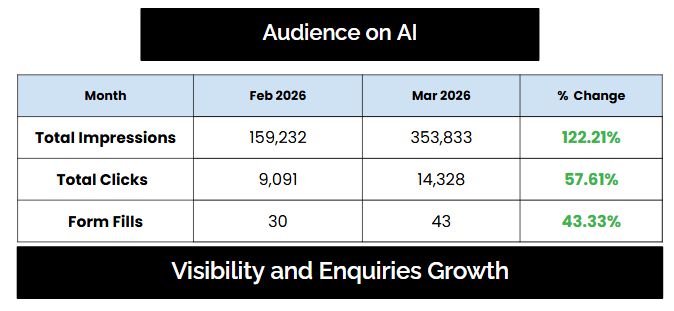
When you optimize for genuine Information Gain and AI citations rather than superficial keyword density, search traffic doesn’t just grow, it converts.
Conclusion & Your Next Move
. You can keep spending your marketing budget chasing blue-link rankings that sit far below the fold, or you can build an AI-proof organic footprint that captures market share across every search interface.
Stop funding content that AI engines ignore and fast-scrolling humans skip.
Ready to see how your brand looks to ChatGPT, Perplexity, and Gemini?
Connect with Kreativ Street today to run an enterprise AI Citation & GEO Audit.
Frequently asked questions
What is a GEO agency?
A GEO agency (Generative Engine Optimization agency) is a modern evolution of traditional marketing agencies. Instead of only optimizing websites to rank in a standard list of links, a GEO agency focuses on AI search visibility. Their core job is to engineer a brand’s digital footprint so that AI engines (such as Google AI Overview, ChatGPT, and Perplexity) select, cite, and recommend the brand inside AI-generated answers.
What does a GEO agency do?
A GEO agency executes a data-driven content strategy aimed at securing an ai citation inside conversational answers. This involves:
- Optimizing content with high “Information Gain”, using zero-fluff answers, crisp data tables, and bulleted summaries.
- Implementing advanced structured data and JSON-LD schema so LLMs can cleanly parse brand details.
- Managing off-page authority building across third-party channels (like Reddit, LinkedIn, and trade press) so AI models find unshakeable consensus around your business.
- Tracking share of citation and brand mentions across various generative platforms.
How is GEO different from SEO?
While traditional seo agencies focus on getting websites listed in organic search links on search engines, generative engine optimization geo focuses on getting synthesized inside the actual answer.
| Feature | Traditional SEO | Generative Engine Optimization (GEO) |
| Primary Goal | Drive organic traffic via blue link rankings. | Earn an AI citation inside generated answers. |
| Targeting | Specific keywords and search volume. | Natural conversational prompts and intent clusters. |
| Visibility | Ranks inside the standard list of search results. | Features at the top of the SERP in Google AI Overview or inside chatbot windows. |
Why do businesses in Gurgaon need GEO?
Gurgaon (Gurugram) is India’s enterprise hub, home to tech leaders, funded startups, and global B2B headquarters. Corporate decision-makers in Cyber City and Golf Course Road are increasingly asking AI tools for vendor recommendations rather than scrolling through endless search links.
Furthermore, Google’s SERP layout now places AI summaries and ads above traditional blue links, pushing organic results below the fold. If a Gurgaon business isn’t optimized for GEO, they risk becoming completely invisible to prospective clients who fast-scroll past classic listings.
How much does GEO cost?
GEO retainer costs depend on business size, competition, and scope. In India, mid-market retainers typically range from ₹75,000 to ₹3,50,000 per month, while global enterprise retainers range from $3,000 to $25,000+ per month. The investment reflects the specialized technical work involved, including schema engineering, off-page link building, prompt tracking, and proprietary research.
Can SEO and GEO work together?
Yes, absolutely. GEO is an evolution of SEO, not a total replacement. Traditional SEO builds the necessary technical health, site speed, and baseline domain authority. GEO builds upon that foundation by optimizing content so AI engines can extract, understand, and cite it. Combining both ensures you capture traditional organic search traffic while dominating AI search visibility.
How long does GEO take?
Because AI models index and update their knowledge bases on varying schedules, GEO is a long-term investment. While initial technical fixes (like structured data and content formatting) can yield AI Overview citations within 30 to 60 days, compounding organic growth and multi-platform visibility across tools like ChatGPT typically take 3 to 6 months of consistent execution.
Which AI platforms does GEO target?
A comprehensive GEO strategy targets all major generative answer engines:
- Google AI Overview & Google Gemini (search-integrated summaries)
- ChatGPT (OpenAI’s conversational model and search features)
- Perplexity AI (answer engine heavily reliant on live citations)
- Microsoft Copilot (integrated across Bing and enterprise search)
