ChatGPT Business Hub: A Detailed Guide to Help You Get Started
ChatGPT Business Hub is OpenAI's new dashboard where a business can claim its profile in ChatGPT, correct its details and see how often ChatGPT mentions it. It launched in beta on 10 November 2026, and most people are already calling it the GMB (Google My Business) for ChatGPT.
We claimed Kreativ Street's profile in the first week. This is the first time OpenAI has given businesses a first-party view of the engagement ChatGPT drives for them.
That is the part worth paying attention to. The GMB comparison explains the profile well enough. It doesn't explain the more useful part: ChatGPT is now telling businesses, in its own numbers, how it uses them in answers. And the numbers don't look like the ones we're used to from search.
Key takeaways
- Business Hub lets you claim and verify your business in ChatGPT, edit your details, add a product feed and see mentions, website clicks and discovery topics.
- Eligible businesses with a website, wherever ChatGPT is available, can claim a profile. That includes businesses in India.
- Claiming your profile doesn't buy you a better spot in ChatGPT's answers. It helps ChatGPT describe you correctly when it does mention you.
- Being cited and being visited are two different things, and you now have to track both.
What is ChatGPT Business Hub?
Business Hub is the business-facing side of ChatGPT. It is part of a wider beta that OpenAI calls Businesses in ChatGPT, and you reach it from the ChatGPT sidebar or at chatgpt.com/business-hub.
OpenAI says 1.2 billion people use ChatGPT every week. A growing share of them use it to compare options before they buy. Until now, a business had no official way to tell ChatGPT who it was, and no official numbers on how it showed up.
The four tools inside it
- Business profile. Your website, description, category, logo, contact details and policies. A verified profile gets a blue tick.
- Product feed. Prices and availability for what you sell, connected through Shopify or uploaded as a feed.
- Insights. Mentions, website clicks and discovery topics, shown for the past 7 or 28 days.
- Business Agent. A branded assistant that answers customer questions from your profile. For now, this is limited to eligible ecommerce and online service businesses in the US.
What it isn't
Business Hub has nothing to do with the ChatGPT plans companies buy for their employees. Those are workspaces for your team. Business Hub is about how your business appears to everyone else.
Is it really the GMB for ChatGPT?
Partly. The comparison with Google My Business (now officially Google Business Profile) holds for the profile and breaks for almost everything else.
Where the comparison holds
You search for your business, claim it, prove you're authorised to manage it, and then keep its details accurate. If you've ever set up a Google listing, the first ten minutes will feel familiar.
Where it breaks
| Google Business Profile | ChatGPT Business Hub | |
|---|---|---|
| Built first for | Local businesses with a location or service area | Online businesses, wherever ChatGPT is available |
| What you manage | Your listing in Search and Maps | The facts ChatGPT holds about your business |
| Performance data | How people found and acted on your listing | How often ChatGPT cited you, how many clicked through, and the topics you were cited for |
| Product data | Products shown on the listing | A product feed with prices and availability |
| Effect on visibility | A complete, accurate profile helps local ranking | OpenAI says claiming doesn't guarantee higher placement or sales |
The last row matters most. On Google, your profile is close to being the result. In ChatGPT, your profile is one source among many that feed an answer. So I'd describe Business Hub as a Google Business Profile with a little Search Console attached, and with less control than either.
Use "GMB for ChatGPT" as a way to explain it to your team. Don't use it to set expectations.
How to claim your business on ChatGPT
- Sign in to ChatGPT and open Business Hub at chatgpt.com/business-hub.
- Search for your business and pick your listing. Online businesses can add one if it's missing.
- Verify the claim by business phone, business email, your website domain or Shopify.
- Complete the identity check. Expect to submit a personal ID and business registration details, as per the country you belong to
- Update your business information so ChatGPT can describe it accurately.
The second check most guides skip
Claiming and verifying are two separate stages. The first proves you have a link to the business. The second, an identity check run through a provider called Persona, proves who you are. Editing, insights and the blue tick open only after the second one is approved.
One more thing worth knowing before you start. OpenAI says eligibility depends on factors including your industry, your location and its own verification and integrity checks, and that you must own the business or be authorised to represent it.
What claiming Kreativ Street's profile was like
We claimed our profile through Business Hub and submitted the personal and company details it asked for, with supporting documents for an Indian entity. Our profile was approved in under an hour. If you have your registration documents ready, expect the process to take an afternoon at most, not weeks.
One detail surprised us. Our listing appears under our registered name, NOT JUST AN AGENCY LLP, and not under Kreativ Street, the name buyers know us by. We haven't been able to change the display name so far, and we've sent feedback to OpenAI about it. If your legal name and brand name differ, check this early.
The profile also shows "Delivery unavailable" and "Returns not accepted" for a marketing agency. Those fields make sense for a store. For a services business, they are a small reminder of who this was built for first.
What our dashboard showed in the first 28 days
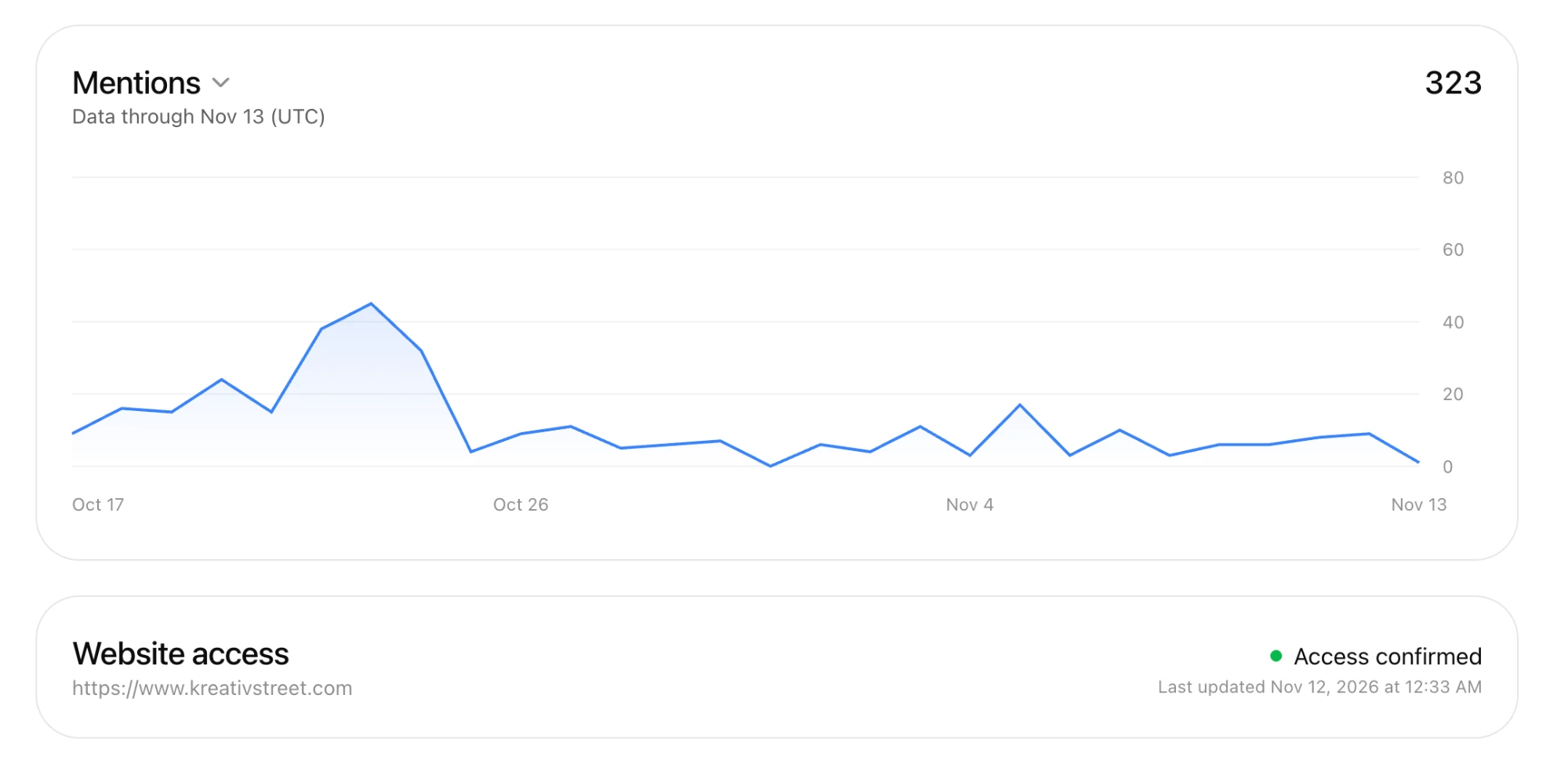
Most guides to Business Hub use OpenAI's demo screens. These are ours, for the 28 days to 13 November 2026. The data goes back to 17 October, which is before Business Hub launched, so you get some history the moment you're verified.
323 mentions, 19 website clicks
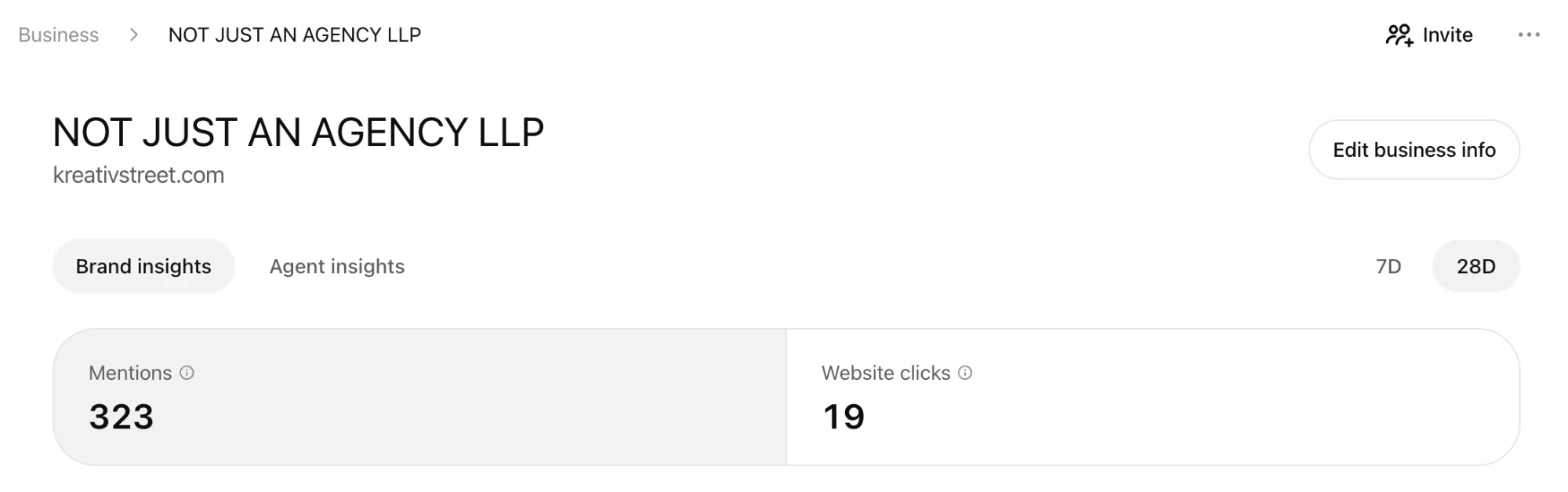
That is roughly one click for every 17 mentions. If you measure ChatGPT only by the traffic it sends, you would see 19 visits and conclude that not much is happening. The mention count says otherwise.
The daily pattern is uneven too. Mentions peaked at around 45 in a single day in late October, then settled at between zero and about 15 a day. We don't yet know what caused the peak, and Business Hub doesn't say.
What counts as a mention
This definition matters. OpenAI describes discovery topics as themes across conversations where your website is cited. Coverage of its help documentation goes further: for an online business, a mention counts when ChatGPT references your website, and your brand name on its own doesn't count.
So a Business Hub mention is closer to a citation than a brand mention. If you use a third-party AI visibility tool, expect its numbers to differ from OpenAI's, because the two are counting different things.
What I read into it, and what I don't
My reading: ChatGPT's picture of a business comes from whichever pages answer the questions people ask. Business Hub is the first place that shows how often that happens, even if only in aggregate.
What I don't read into it: this is one agency, four weeks, and a beta product. It tells us where to look. It doesn't prove a pattern.
What it means for B2B tech brands
If you market an IT services or SaaS company, most of the launch wasn't built for you. You have no product feed to connect. The Business Agent isn't available outside US ecommerce and online services. And your buyers rarely go from an AI answer to a purchase in one click.
What you do get is measurement, and for B2B that is the valuable part.
- Mentions show whether you're in the answer at all. A buyer shortlisting vendors may ask ChatGPT three or four questions and never visit your site until much later. Clicks will undercount that influence. Mentions get closer to it.
- Discovery topics show what you're known for. Compare the topics ChatGPT cites you for with the offerings you want to be known for.
- The profile fixes the basics. Category, description, website and contact details are small things, until an AI answer gets them wrong in front of a procurement team.
One caution for anyone reporting upwards. These are aggregate counts over 28 days, in a beta. They are a good reason to start a baseline. They are not yet a pipeline metric.
What it means for consumer and ecommerce brands
If you sell products, Business Hub does more for you today than for anyone else.
The product feed
You can share product details, prices and availability with ChatGPT by connecting a Shopify store or uploading a product feed. Eligible Shopify products are already in ChatGPT through Shopify Catalog. This puts your own product data in front of ChatGPT, instead of leaving it to piece prices together from whatever it finds.
OpenAI says ChatGPT may use this information, not that it will, and claiming doesn't guarantee higher placement or sales. Treat the feed as accuracy work. A wrong price or an out-of-stock item in an AI answer costs more trust than a missing one.
Business Agents, US only for now
Eligible ecommerce and online service businesses in the US can publish a Business Agent on their profile. It answers questions about products and policies, and conversations with it are labelled separately from ChatGPT's own answers. Businesses can also sponsor the agent as the destination for a ChatGPT ad.
Brands in India can't use this yet. It is still worth preparing for, because the agent can only be as good as the information you give it.
One version of every policy
Your return window, delivery terms and pricing now live in at least three places: your website, your feed and your profile. If they disagree, a customer will find the disagreement before you do. Pick one source of truth and update the others from it.
Can Indian businesses use it?
Yes, if you're eligible. We are an Indian business, and our profile is claimed and verified.
- Online businesses can claim, wherever ChatGPT is available. OpenAI says claiming is initially open to eligible businesses with a website, which covers most services, SaaS and ecommerce companies.
- Local stores and restaurants are not OpenAI's focus at launch. If you run a clinic, a restaurant or a retail outlet in India, check whether your business appears, and expect to wait if it doesn't.
- Business Agents are US only for now.
OpenAI hasn't published a country list, and there were reports of claims outside the US being waitlisted on launch day. If your business doesn't appear when you search, that is the likely reason. Check again in a few weeks.
What Business Hub can't change
Claiming your profile doesn't buy you a better spot. This is the point most likely to get lost as agencies start selling "ChatGPT profile optimisation".
- Recommendations. OpenAI says ChatGPT continues to make independent recommendations, and that claiming doesn't guarantee higher placement or sales. Sponsored placements are labelled and kept separate from ChatGPT's answers.
- Other sources. ChatGPT still reads your website, reviews, directories and anything else it finds. Your profile is one input.
- Timing. OpenAI says ChatGPT may use the information you provide. A saved change won't necessarily show up in every answer straight away.
- Conversations. You see aggregate counts. You never see what people asked, including chats with your own Business Agent.
What earns the recommendation hasn't changed. ChatGPT cites businesses whose expertise is clearly explained on pages it can read and in places it trusts. Business Hub makes sure it gets your facts right when it does. That work sits in generative engine optimisation and search engine optimisation, not in the profile.
Your first 30 days
For every business
- Claim and verify your profile. It's free, and it takes one person with authority and the right documents.
- Check the name, category, description and website. Fix what's wrong before you add anything new.
- Record your starting numbers: mentions, website clicks and top discovery topics. Take a screenshot, because the window only goes back 28 days.
- Compare your discovery topics with what you want to be known for. Write down the gaps.
If you're a B2B business
- Look at which pages are likely to be earning your citations. If blog or support pages are doing the work your service pages should, that is your content brief.
- Add ChatGPT mentions to your monthly reporting as a trend, with no targets attached yet.
If you sell products
- Connect your product feed, and check prices and availability against your site.
- Align your return and delivery policies across your site, feed and profile.
What I wouldn't do in the first month: rebuild a content strategy around a beta dashboard, or pay anyone who promises to rank you higher in ChatGPT through your profile.
What I think comes next
These are guesses, and I'd hold them loosely.
- Business Agents will reach India. OpenAI has described this launch as an early step and said it plans to expand markets and categories. Our own Business Hub, for an Indian business, already shows an Agent insights tab, which suggests the rollout isn't far off.
- Marketers will check ChatGPT mentions the way they check Search Console. Once a first-party number exists, it finds its way into the monthly report. The harder job will be explaining what it does and doesn't mean.
- Third-party AI visibility data will face harder questions. Tools such as Profound and Semrush's AI visibility tracking, which estimate your visibility by running sample prompts, will now sit next to OpenAI's own counts, and the two won't match. Some of that gap is a difference in definitions. Some of it will be a question of accuracy, and buyers of those tools will start asking which.
The short version
Business Hub doesn't change what makes a business worth recommending. It changes how much you can see. For the first time, ChatGPT will tell you how often it cites you and what for.
Claim the profile, get your facts right, and spend a few minutes with the numbers. Ours told us something about how we're found that we didn't know a week ago.
If you'd like a second pair of eyes on what your Business Hub data is saying, talk to us.
Frequently asked questions
What is ChatGPT Business Hub?
It is OpenAI's dashboard for managing how a business appears in ChatGPT. A verified business can edit its profile, connect a product feed and see mentions, website clicks and discovery topics. It launched in beta on 10 November 2026.
Is ChatGPT Business Hub the same as Google My Business?
No, though the comparison is useful. Both let you claim and manage a business profile. Business Hub adds data on how often ChatGPT cites you, and unlike a Google listing, a claimed profile doesn't promise more visibility.
Is ChatGPT Business Hub free?
OpenAI's announcement doesn't mention a fee for claiming a business or using insights, and we paid nothing to claim ours. The paid option is sponsoring a Business Agent as the destination for ChatGPT Ads.
Is ChatGPT Business Hub available in India?
Yes, for eligible businesses with a website. Business Agents are limited to the US for now.
Does claiming my profile improve my visibility in ChatGPT?
Not directly. OpenAI says ChatGPT continues to make independent recommendations, and that claiming doesn't guarantee higher placement or sales. It helps ChatGPT describe your business accurately when it does mention you.
Can I see what people ask ChatGPT about my business?
No. Business Hub shows aggregate counts and themes. It doesn't share individual prompts or conversations.

Author
Neeraj Sancheti
Founder & CEO
Neeraj Sancheti founded Kreativ Street in 2016 and has spent the years since arguing that marketing should create value that outlasts the campaign. That belief became Slow Marketing: think deeply, move deliberately, build what lasts. He leads the agency’s senior client relationships, where his first question is usually what needs to change, not what needs to be made. He also hosts The Slow Marketing Podcast. Before Kreativ Street, he led social media and was a part of the brand strategy team at OYO (now Prism).